How we work
Think about the last thing you bought to grow the business. The ads, the CRM, the freelancer, the tool with the free trial. It didn't fail because it was bad. It failed because it was bolted onto a lane that was already cracked. Nobody checked the lane first. We do.
Your business stands on three pillars: how people find you, how they become clients, how you deliver. Put weight on a cracked pillar and it doesn't hold better because the weight is expensive.
A chatbot on a business with no written offer says no faster. A follow-up sequence on a business that never asks why people said no sends prettier emails into the same silence. An "AI employee" on a delivery process that lives in your head does the wrong thing tirelessly, then you fix it at eleven at night.
That's what "AI will not solve a problem that sits underneath it" means in practice. The software works. The lane doesn't.
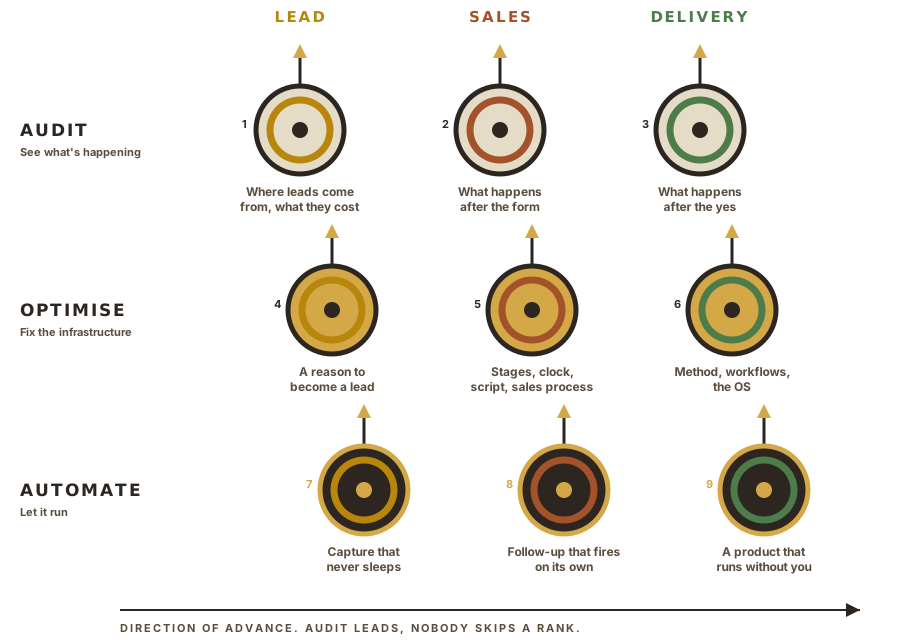
Every business has the same three lanes: Lead gen, Sales, Delivery. We take each lane through the same three steps: Audit, Optimise, Automate. Nine positions. The Audit rank leads. Nothing moves to the second rank until the first has held.
Read it left to right for what we look at. Read it top to bottom for the order we do it in. Most businesses walk in wanting the bottom row. We start at the top, every time, because the top row is where the money is leaking and the bottom row is where it gets hidden.
Audit
How many new leads last month, and can you say the number without looking. Where they came from, and whether one source carries the whole business. What happens to the pipeline if referrals stop tomorrow. Whether a stranger could repeat in one sentence why someone should hire you. Whether you have a list you could message today and get replies. Who answers a new lead, and how long it takes.
Of every ten leads, how many pay. When someone says no, whether you know why or guess. Whether there's a written offer with a price, or every deal is a custom quote. What happens to deals when the person who closes is sick for two weeks. Whether quiet leads get followed up on a schedule or when someone remembers. How long from first contact to money in the bank.
How your week splits between working for clients and working on the business. Whether the way you deliver is written down anywhere a new hire could follow. The one task you repeat every week that makes you sigh. Whether you could take 30% more clients next month without hiring. Whether every client gets the same experience regardless of who handles them. How you find out a client is unhappy.
These are the questions in the free diagnostic. You can run them on yourself in six minutes. The audit runs them on your numbers, your inbox and your calendar, with someone who has done it a few hundred times.
Optimise
Optimise is where the business changes and it's the part nobody sells you, because most of it isn't software.
The offer, written down: what it is, who it's for, what it costs. The first five minutes after a lead arrives: who, how fast, what they say. The follow-up rhythm on paper: day one, day three, day seven. The delivery method, step by step, the way you'd hand it to someone new tomorrow. A signal that tells you a client is unhappy before they're gone.
None of that needs a licence. All of it decides whether the next thing you buy works.
Automate
Once a lane is written down and working, AI is the best hire you'll make. It answers every lead in seconds, in your words. It chases the quiet ones on the schedule you set. It runs the intake, the quoting, the invoice collection, without a bad Tuesday.
One rule: nothing gets automated that isn't written down first. Automating chaos gives you faster chaos.
The beliefs we reframe
AI amplifies what's there. Amplified silence is still silence.
Sometimes. First: why would anyone become your lead, and what happens to them after? Most businesses don't have a lead problem. They have a nothing-happens-after-the-lead problem.
A lead who found you through a referral and a lead who clicked an ad at midnight are different animals. Treating them the same wastes one and annoys the other.
The first three to five minutes decide most of it. Not hours. Not tomorrow.
You need one brain, not five. Five vendors, five opinions, no one accountable for whether money came in.
Compare it to the cost of another year on the same lanes. That's the number that matters.
Six minutes, three lanes, one priority. Then, if you want it, 15 minutes with Roi to read it together. Nobody gets the 15 minutes without the six.